Rama 9–Krungthep Kreetha is often described as if it were one new neighbourhood. It is better understood as an eastern Bangkok corridor: Rama 9 and Pattanakarn on the city side, the established Krungthep Kreetha community in the middle, and Srinagarindra–Rom Klao leading toward Suvarnabhumi.
The useful claim is not that this has become downtown. It has not. The useful claim is that the corridor now combines four things that are difficult to assemble elsewhere: international-school geography, road access to the airport and central Bangkok, existing rail alternatives, and enough low-rise land to create genuine private houses rather than oversized apartments.
That combination is valuable for a particular household: a family that drives, uses an international school in eastern Bangkok, travels regularly, and wants privacy and usable space more than a Sukhumvit address.
The market evidence is stronger than the slogan
Krungsri Research's 2026–2028 housing outlook expects low-rise demand to be supported by owner-occupiers in middle- to upper-income groups and says new projects will concentrate in outer locations near international schools. Its detailed Bangkok outlook specifically names Krungthep Kreetha Road as a high-potential eastern location and connects demand there with young families of business owners and executives seeking hospitals, schools, privacy, safety, and more usable space.
Developer behaviour supplies a second signal. Sansiri records THB 6.1 billion of sales at Narasiri Krungthep Kreetha within one month of launch. That does not prove that every house in the district is correctly priced, and it is not a promise of appreciation. It does show that affluent families have already accepted Krungthep Kreetha as a luxury-house address at meaningful scale.
The correct conclusion is therefore narrower than the marketing language: demand is real, but the quality of the individual site, house, legal title, access, construction, and asking price still determines whether a purchase makes sense.
The school run is the district's most durable advantage
Families do not experience a location through a map pin. They experience it twice a day, at school drop-off and pick-up.
Brighton College Bangkok lists its campus at Krungthep Kreetha Soi 15, while Wellington College International School Bangkok is at 18 Krungthep Kreetha Road. Their presence makes the district useful before any future infrastructure arrives. It also explains why large-house demand here is tied more closely to family logistics than to office commuting alone.
Proximity should still be tested, not assumed. A five-kilometre route can behave very differently at 7:15 a.m. and 4:00 p.m. Before buying, drive from the exact gate of the property to the relevant school on a normal weekday. Repeat the return trip, check alternative approaches, and ask the school about bus coverage. A short school run that works reliably can return more time to a family than a prestigious postcode that creates two difficult journeys every day.
Connectivity comes in layers
The first layer is the road network. Rama 9, Pattanakarn, Srinagarindra–Rom Klao and the motorway system create several approaches toward central Bangkok, Suvarnabhumi, and the eastern region. NORMAL's current estimates from ARQ10 are 15–20 minutes to Suvarnabhumi, 20–25 minutes to Thonglor or Ekkamai, and 5–7 minutes to the M7 on-ramp, but these are traffic-dependent estimates rather than guaranteed journey times. Test the routes at the hours that matter to you.
The second layer is rail that already operates. Hua Mak is served by the Airport Rail Link, and the MRT Yellow Line has operated since July 2023, connecting the Lat Phrao–Srinagarindra–Samrong axis and interchanging with the Airport Rail Link in the Hua Mak area. For a car-owning household, this is best viewed as useful backup and staff or family mobility, not proof that every home in the corridor is walkable to a station.
The third layer is planned rail. Civil construction on the eastern Orange Line is complete, but passenger service is not yet operating. MRTA's published target is to open the eastern section before May 2028. Infrastructure schedules can move, so a purchase should work with today's roads and rail. Treat the Orange Line as potential future improvement, not as the reason the house works now.
The fourth layer is airport access. This matters differently from a city-centre commute. For regional business owners, internationally mobile families, and households with frequent visitors, being on the airport side of Bangkok can remove an awkward cross-city journey. Buyers who rarely fly may give this advantage less weight.
What the area does not solve
Krungthep Kreetha remains a car-oriented district. Some daily needs are close by road, but it does not reproduce the walkability, restaurant density, or door-to-platform convenience of central Sukhumvit. Traffic varies. Large detached houses also require more maintenance, staffing decisions, utilities, and landscape care than a condominium.
There is also no single experience called Krungthep Kreetha. A house directly exposed to a busy road is different from one inside a quiet soi. A deep site with limited alternative access is different from a site near several connecting roads. Drainage history, surrounding construction, aircraft noise perception, school traffic, and the final approach to the gate should be checked property by property.
This is why broad price-per-square-metre comparisons are weak. Land area, built area, usable planning, privacy, completion quality, common-area obligations, road access, and the cost of finishing or furnishing the home all change the real value.
A practical viewing test
Visit once in daylight and once near the evening rush. Drive the school route. Time the airport or office route you actually use. Stand outside the house with no sales conversation and listen. Check how guests, deliveries, staff, and four cars would arrive. Ask what is completed, what is included, what remains unfurnished, and which claims are written into the sale documents.
Inside the house, ignore total square metres for the first ten minutes. Follow a normal day: arrival, groceries, children's bags, grandparents, staff circulation, dinner, pool supervision, work calls, laundry, storage, guests, and bedtime. A large house is only successful when those movements do not continually collide.
Where ARQ10 fits
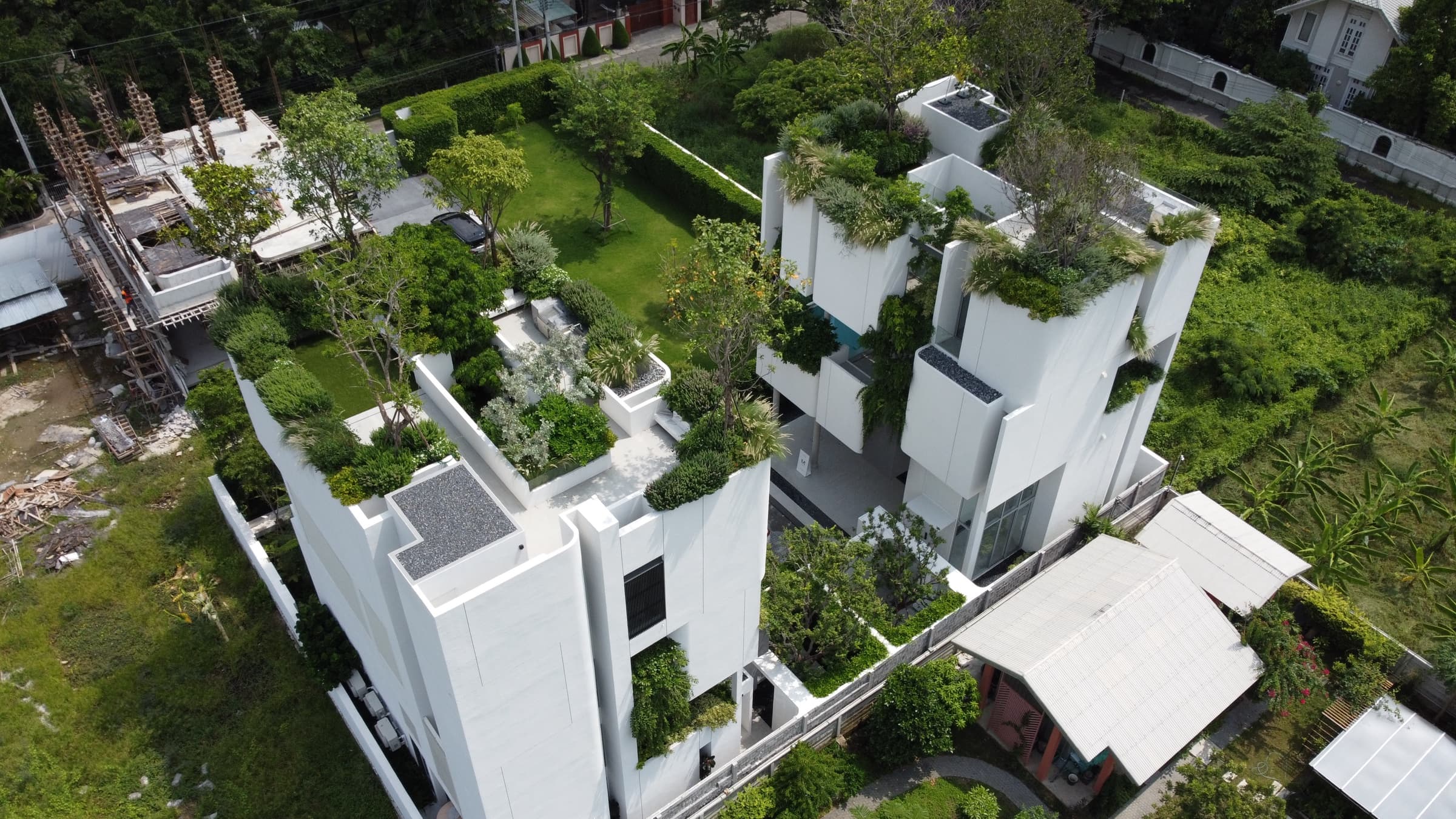
ARQ10 is on Soi Krungthep Kreetha 8, set away from the main corridor on a private street of ten detached homes. The available ARQ10 L-House is completed and ready to inspect: 615 sqm, four en-suite bedrooms, four covered parking spaces, a private pool, private lift, naturally lit basement, and rooftop garden. Bathrooms, air-conditioning, core building systems, pool, lift, and landscape are complete; loose furniture is not included.
That ready-now condition is important. It lets a buyer test the location and the actual house on the same visit. The decision does not have to rest on a rendering, a future rail opening, or a general claim that the district is rising. It can rest on whether this route, this street, and this completed home make family life work better today.