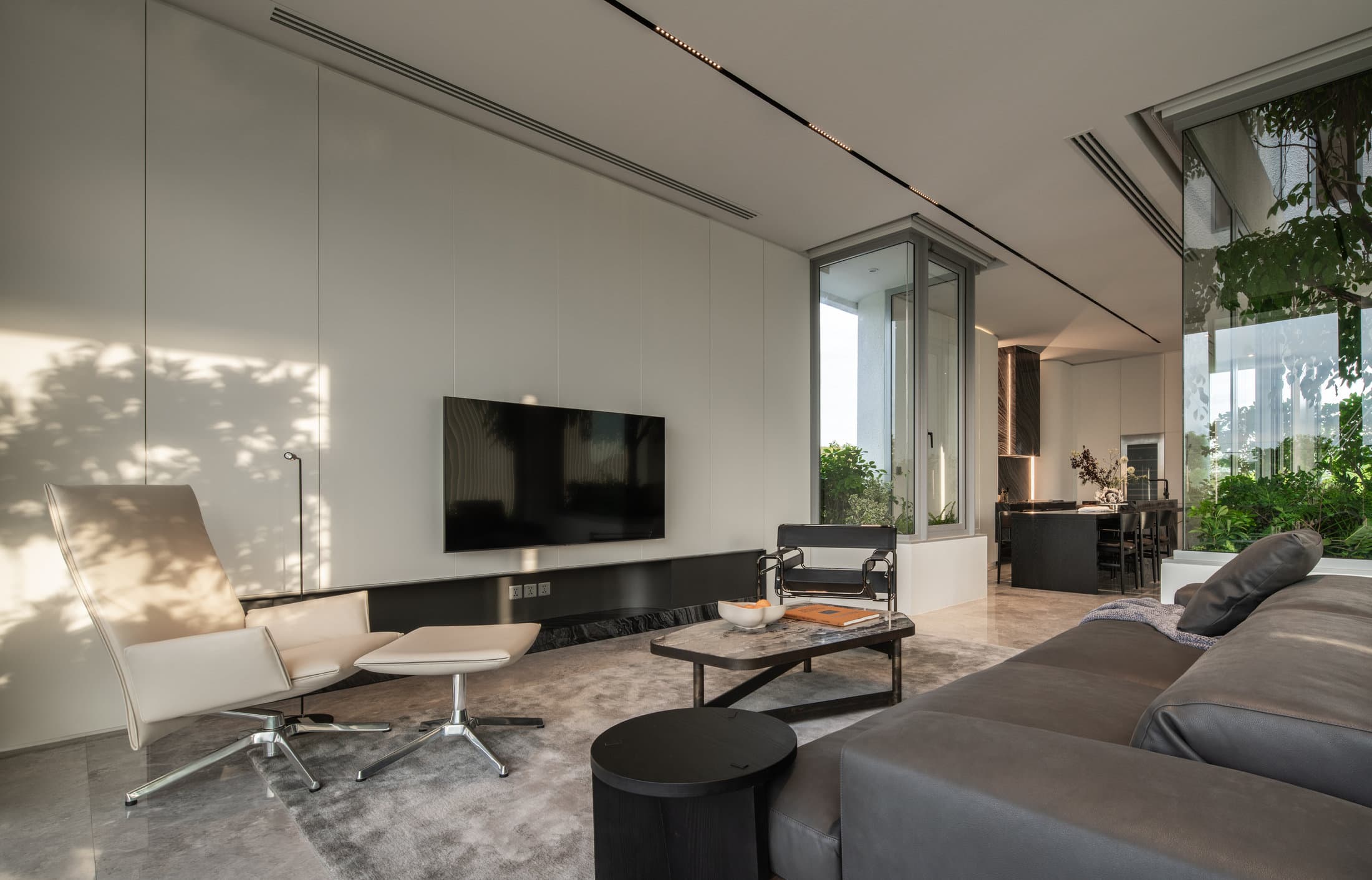
There is a point in family life when the view stops being the most important thing about a home.
The change rarely arrives as one dramatic decision. It appears as a sequence of small frictions: a second child, parents staying for longer visits, a driver waiting downstairs, sports equipment with nowhere to go, two cars competing for one allocated space, a guest call from the lobby, or a quiet room that is never quite quiet.
At that point, the real question is not whether a luxury condominium or a private house is more prestigious. It is which one removes more friction from the life your family actually lives.
What a luxury condominium still does exceptionally well
A good luxury condominium is a strong answer for the right household. It can put you close to work, restaurants, transit, and the centre of the city. Security, common-area maintenance, deliveries, and many repairs are handled by a management team. A high floor can provide a view no private house can reproduce. For one or two adults, frequent travellers, or anyone who values a lock-and-leave home, that simplicity is real luxury.
The mistake is not choosing a condo. The mistake is assuming it must keep working after the household has changed.
The better comparison is daily life, not price per square metre
Families often compare properties through price, usable area, bedroom count, and location. Those numbers matter, but they do not show how a home operates at 7:00 in the morning or 7:00 at night.
Ask more practical questions. Can children and adults follow different routines without disturbing one another? Is there a real place for grandparents, guests, or a live-in helper? Can a driver arrive without blocking the household? Is there storage for luggage, bicycles, golf bags, school projects, and the objects a family accumulates over years? Can you host dinner while another part of the house remains private? Can a pet reach outdoor space without using a shared lift?
These questions reveal the difference between having more square metres and having more control.
Privacy changes when the whole journey home is yours
Condo privacy begins at the front door. Before that door, the route is shared: arrival court, lobby, lift, corridor, parking structure, and common facilities.
In a detached house, privacy can begin at the gate. The arrival, parking, lift, pool, garden, and internal circulation belong to one household. There are no neighbours directly above or below, no call from reception before a guest arrives, and no need to book a shared room for a family gathering.
That difference may sound subtle on a floor plan. In daily life, it changes how freely a family moves.
A large home should separate rhythms, not just add rooms
More space is only useful when it is organised well. A private house can separate public life from private life: guests and dining on one level, bedrooms on another, a retreat or media room away from both, and service functions that do not cross the main family spaces.
Vertical living can work particularly well when a private lift connects clearly defined floors. One family still owns the whole journey, but different generations can keep different schedules. Children can be active without turning every room into a playroom. Parents can stay close without giving up independence. Work, rest, entertaining, and storage do not have to compete for the same open-plan space.
The goal is not a bigger house for display. It is a house that lets people be together without requiring them to do everything together.
Cars, staff, storage, and guests are part of luxury too
Luxury property is often photographed without the operational details of life. Yet those details create much of the daily experience.
A household with several cars needs more than a prestigious address; it needs parking that works without constant rearranging. A family with staff needs a respectful service area and circulation that supports the household. Frequent hosts need guest flow that does not expose the private rooms. Long-term residents need storage that can absorb a real life rather than forcing it into rented lockers.
These are not glamorous features. They are the infrastructure of calm.
The honest trade-off: a house gives control and responsibility
A private house is not automatically the better choice. It asks more from its owner. The pool, garden, façade, roof, equipment, security, and preventive maintenance are private responsibilities. Utilities can be higher. A six-level home makes a lift important rather than optional. If the household travels constantly and wants almost no operational involvement, a well-managed condo may remain the more intelligent answer.
The benefit of a house is control. The cost of that control is responsibility. A serious comparison should acknowledge both.
Why the Bangkok map is changing for families
Central Bangkok remains compelling for households whose life is organised around the CBD. But families increasingly evaluate another map: school gates, airport access, hospitals, expressways, groceries, and the time spent together between those points.
That helps explain the rise of low-density districts such as Rama 9–Krungthep Kreetha. The area offers private-house scale while remaining connected to international schools, Hua Mak, the motorway network, Rama 9, and Suvarnabhumi. The broader market supports that logic: Krungsri Research's 2026–2028 housing outlook expects low-rise demand to recover gradually through real owner-occupier demand and notes that new projects are likely to concentrate in areas close to international schools.
This does not make the area right for everyone. It makes it relevant to families whose daily map no longer begins and ends in central Sukhumvit.
Ready now removes a different kind of friction
The condo-versus-house decision is also a certainty decision. An off-plan house may promise personalisation, but it carries a construction timeline, specification decisions, inspections, and the risk that the completed spaces feel different from the drawings.
A completed house can be tested before commitment. You can walk the route from parking to kitchen, check how the lift connects the floors, stand in the bedrooms, inspect the light, hear the surrounding street, and decide whether the spaces fit the household you already have.
For a family moving on a school calendar, relocating to Bangkok, or simply tired of waiting for the next stage of life, that certainty has value.
ARQ10 L-House as a ready-now example
ARQ10 L-House is a completed private residence in Krungthep Kreetha: 615 square metres across six levels, with four en-suite bedrooms, a private pool, private lift, rooftop garden, hidden basement, four-car covered parking, and dedicated staff space.
The house is delivered unfurnished so the loose furniture and soft interior can reflect its owner. Bathrooms, air-conditioning, core building systems, finishes, pool, and landscape are already in place. The buyer can inspect the real architecture now rather than buying from a future promise.
Its strongest argument is not that every condo buyer should move to a house. It is that some families reach a stage where privacy, separation, storage, parking, and certainty become more valuable than a shared address and a distant view.
When that happens, the next luxury is not necessarily higher. It is more personal.