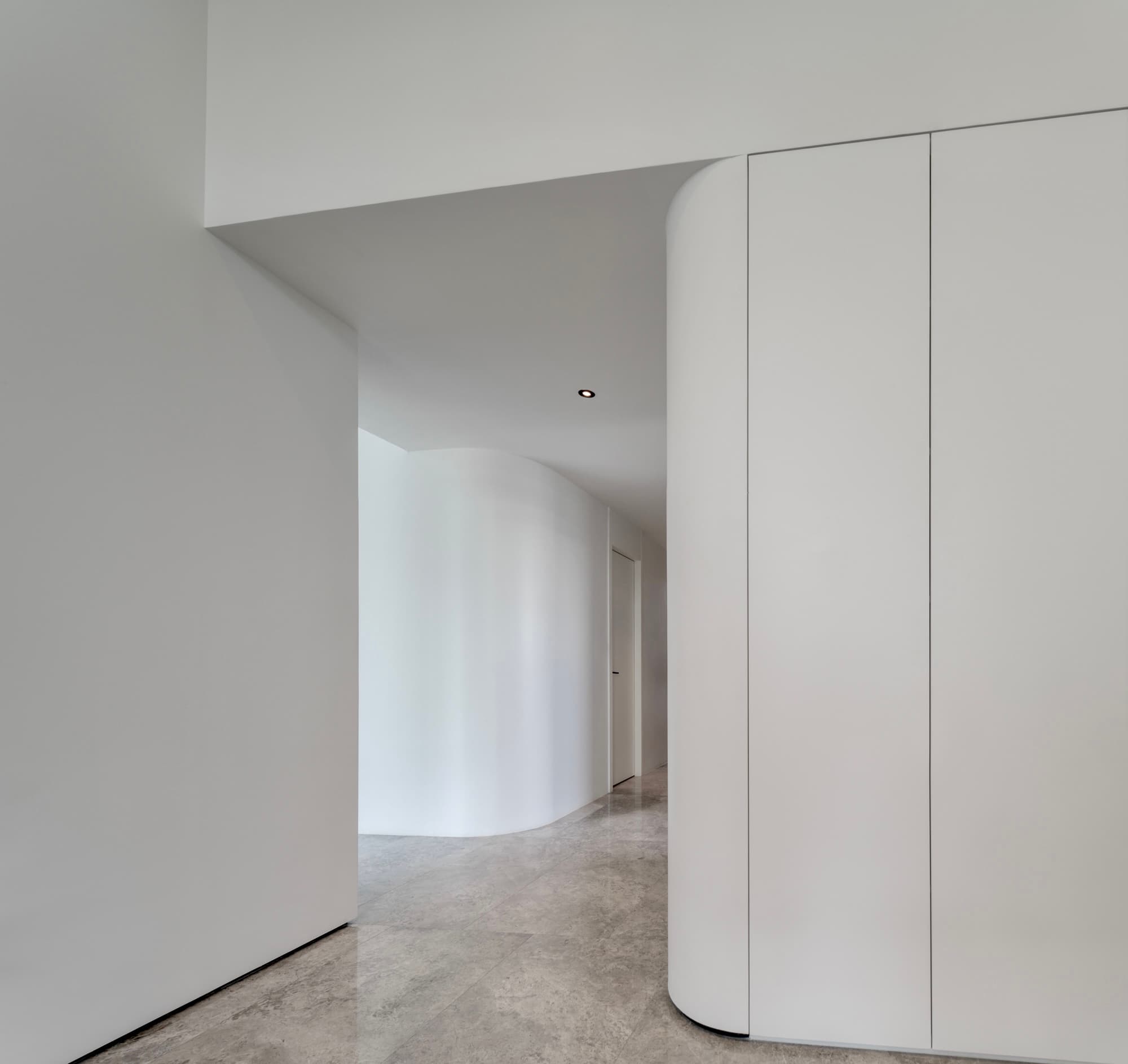
There is a version of luxury residential development where architecture is applied at the end — a finishing layer over decisions that were made long before any drawings existed. ARQ10 was not built that way.
Every ≠ NORMAL project has been designed by IDIN Architects, a Bangkok studio whose residential and hospitality work is internationally published and locally serious. The relationship has produced six projects since 2017. ARQ10 is the most recent, and the most complex.
What IDIN Architects builds
IDIN Architects is a Bangkok-based practice with a body of work that sits outside easy categorisation. Their buildings are not minimal in the fashionable sense — they are considered. There is a difference. Minimal can mean empty. Considered means that every element is there for a reason, and nothing is there without one.
Their work has appeared in Archdaily and Designboom — publications that operate on a global stage and that do not feature projects as a courtesy. ARQ10 is an Architizer A+ Awards Finalist. These recognitions matter not as credentials to display, but as evidence that the work holds up under scrutiny from people whose job is to scrutinise it.
The design language at ARQ10
The site is Soi Krungthep Kreetha 8. Ten detached houses arranged in two rows of five. The brief asked for homes that feel genuinely rooted in their location — not imported, not generic, not aspirational in the hollow sense that word often carries in property development.
The design response is built on three things: restraint, light, and green.
Curved geometry appears throughout — in walls, in thresholds, in the transitions between floors — not as decoration but as a device that softens the vertical ambition of the buildings and makes movement through them feel natural rather than effortful. Natural materials are used with patience: stone, timber, concrete with texture that records the passage of time rather than resisting it. And at the centre of each house, a double-height living space organised around a courtyard logic draws outside light and air deep into the plan, making each home feel larger and quieter than its footprint would suggest.
The two typologies
ARQ10 contains two house types, each a complete proposition on its own terms.
The L-House is six storeys and 615 square metres. A private pool occupies the third floor — positioned there deliberately, to give the water a relationship with sky rather than ground. A hidden basement sits below grade, unprogrammed by design: it could be a wine cellar, a private theatre, a room with no name yet. A rooftop garden and private lift complete the vertical section. The architecture makes the ascent worthwhile at every level.
The M-House is five storeys and 470 square metres. Pool, rooftop garden, private lift. The same material and spatial thinking at a different scale — not a reduced version of the L-House, but a separate argument for how a Bangkok house could be.
Landscape across the development was designed by T.R.O.P., the Bangkok landscape studio. The distinction between where the building ends and where the garden begins is, by design, unclear.
On awards and press
ARQ10 has been an Architizer A+ Awards Finalist and featured in Archdaily and Designboom. We mention this briefly and then move on, because a house is not a trophy and an award does not tell you whether the light in the kitchen is right at seven in the morning.
What the recognition does confirm is that the work was taken seriously by people outside the project — which is, at minimum, a useful data point.
What the work produces over time
A house designed with genuine spatial intelligence tends to age differently from one optimised for the sales brochure. The proportions hold across seasons. The materials develop character rather than showing wear. The rooms remain interesting after the novelty has passed.
This is not a claim unique to ARQ10. It is simply what happens when architecture is treated as the primary discipline, not a service brought in after the product decision has already been made.