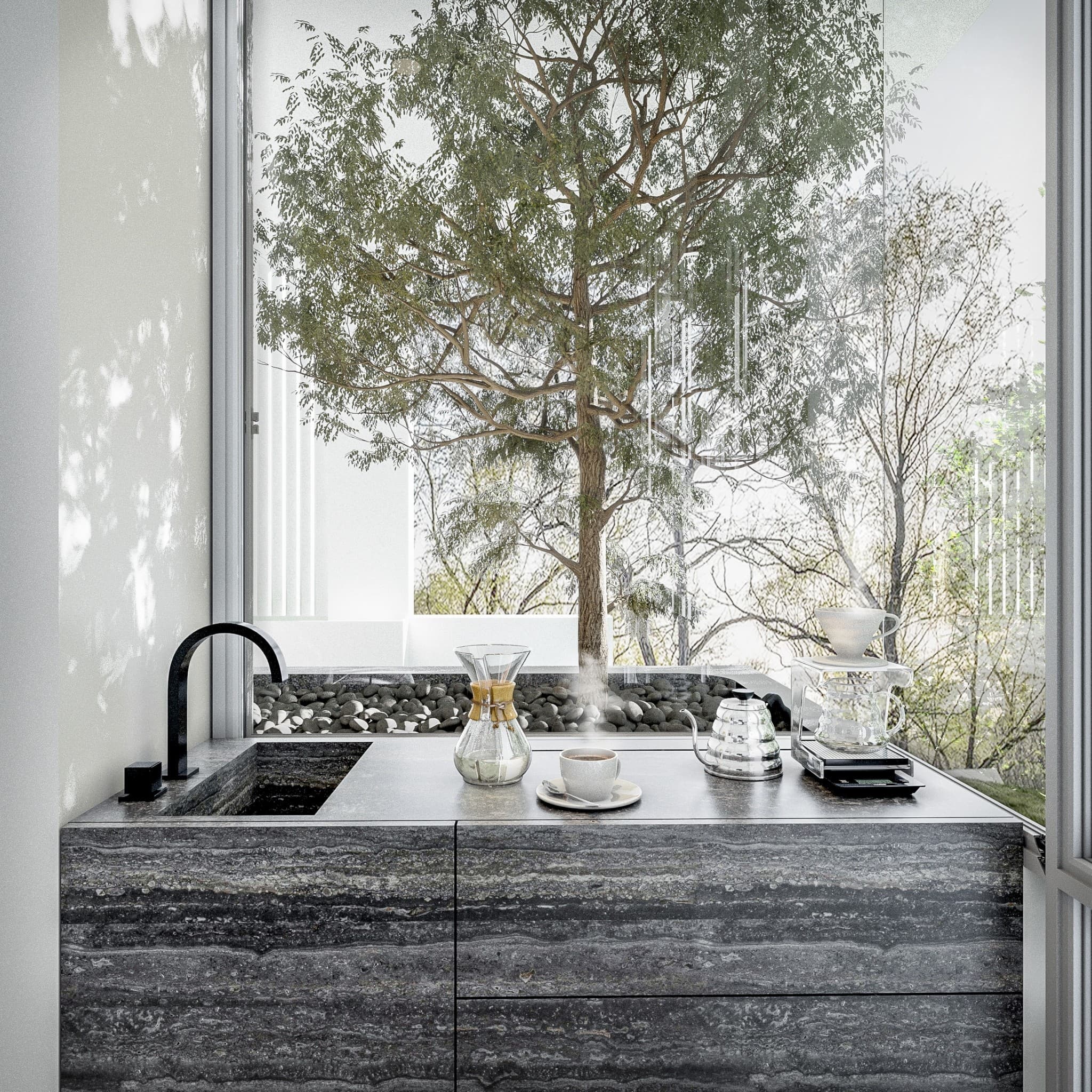
The difficult part of a 615 sqm city house is not fitting in more rooms. It is preventing the house from becoming a stack of disconnected floors.
ARQ10 L-House stands on 71.70 sq.wah of land, approximately 286.8 sqm, yet provides 615 sqm of built area across six levels: basement, Floors 1–4, and rooftop. That ratio creates a clear architectural problem. Family members need privacy without isolation. Guests need a graceful route that does not expose bedrooms. Staff and service movement need to work without dominating family life. Deep floors need daylight and air. Landscape must be present even when there is limited ground around the building.
The answer was not one signature object. It was a sequence of planning decisions made by IDIN Architects, with landscape by T.R.O.P. Terrains + Open Space. IDIN's official project record lists design beginning in 2019, project completion in 2022, IDIN as architect and interior designer, and T.R.O.P. as landscape designer.
Those credits matter, but they are not the starting point for judging the house. The starting point is whether the plan improves an ordinary Tuesday.
1. Zones come before rooms
The six levels are not six versions of the same floor.
The basement combines a naturally lit sunken court, multi-purpose room, and storage. Floor 1 receives cars, family, guests, and service movement. Floor 2 provides a quieter bedroom level. Floor 3 is the shared family centre with living, dining, pantry, terrace, and private pool. Floor 4 holds the more private suites, wardrobes, bathrooms, laundry, and terraces. The rooftop becomes a planted outdoor room rather than leftover mechanical space.
This vertical gradient moves from arrival and service to family life, then privacy, then open sky. It allows a guest dinner, children's pool time, a work call, laundry, and a quiet bedroom to happen in the same house without every activity sharing one open plan.
It also gives the private lift and stair a clear purpose. They are not luxury accessories added to a tall house; they are the circulation system that makes six levels usable for groceries, luggage, grandparents, daily chores, and long-term living.
2. Landscape is environmental infrastructure
On a compact urban plot, a conventional garden around the perimeter would be visible from only a few rooms. ARQ10 instead breaks landscape into planted courts and terraces distributed through the section of the house.
T.R.O.P.'s published landscape account describes pocket gardens flowing from the ground level to the rooftop, with plant selection responding to different light conditions. Openings through the building bring light and airflow toward the centre and down to the basement. The landscape therefore performs several jobs: view, shade, privacy buffer, orientation, and a changing sense of time.
This is why a bathroom can look into planting without looking toward a neighbour, a corridor can end in daylight rather than a wall, and a basement can open to a sunken court instead of feeling buried. The greenery is not one feature outside the living room. It is repeated wherever the plan needs relief.
Claims about lower heat or better ventilation should still be judged in the completed house, not accepted as a sustainability label. Open the doors. Stand in the sunken court. Visit at a hot time of day. Check which windows operate, where shade falls, how air-conditioning zones are arranged, and how the planting will be maintained.
3. The pool belongs to family life
Many houses place the pool at ground level beside the formal arrival space. ARQ10 raises it to the main family level, beside living, dining, pantry, and terrace.
That decision changes daily use. A parent can see the water from the living area. Lunch, homework, guests, and pool time can share a connected zone. When nobody is swimming, the pool remains part of the view rather than an amenity hidden below.
The architect's published explanation of ARQ10 says the pool is shaded for all-day use and that the water and central open void help create a more comfortable atmosphere between the family level and bedrooms above. The practical value is more important than the description: supervision, gathering, and visual calm are built into the centre of the plan.
4. The basement is designed as occupied space
A basement usually solves parking, plant, or storage and is then forgotten. The L-House uses a sunken landscaped court to bring daylight and a green outlook to the lower level. It can hold a cinema, music room, wine room, gym, studio, children's room, or serious storage without forcing that activity into the formal family areas.
Flexibility is not the same as promising every use. A buyer should verify ceiling height, ventilation, waterproofing, drainage, acoustic separation, air-conditioning, power, egress, and the exact fitted condition before assigning a function. The value is that the room exists as a real, inspectable volume with light and vertical connection, not that one lifestyle has been preselected for the buyer.
5. Privacy is built through views and movement
Urban privacy is not achieved simply by closing every facade. A sealed house loses the light and landscape that make a large home pleasant.
ARQ10 uses curved and screened exterior surfaces, planted setbacks, inner courts, changing floor levels, and controlled sightlines. The aim is to open rooms toward greenery and sky while reducing direct views toward neighbouring homes. Inside, guest, family, bedroom, and service routes overlap only where interaction is useful.
This should be tested during a viewing. Stand where a neighbour might look in. Follow the delivery route. Walk from parking to pantry, maid's room to laundry, guest arrival to dining, bedroom to pool, and basement to the lift. Good privacy is visible in what you do not have to cross.
6. The rooftop is a garden with a job
The rooftop continues the landscape sequence upward. Planting supplies shade, softens the view from upper rooms, and gives the house an outdoor retreat above the family and bedroom levels. T.R.O.P.'s account also describes the planted roof as insulation against urban heat.
As with every roof garden, beauty depends on technical maintenance. A buyer should inspect waterproofing records, drainage outlets, irrigation, root barriers, access, lighting, wind exposure, plant replacement, and the boundary between landscape and building systems. Quiet architecture includes the invisible details that keep the garden working after the photographs are taken.
7. Completion without prescribing one interior
The available ARQ10 L-House is completed but delivered without loose furniture. Bathrooms, air-conditioning, core mechanical and electrical systems, pool, lift, finishes, and landscape are in place. The buyer can therefore evaluate the architecture at full scale and then decide whether to furnish simply or undertake a more personal interior fit-out.
That is different from buying an unfinished shell. It is also different from buying a fully staged house whose furniture hides circulation or storage problems. Bring the measurements of your dining table, art, wardrobes, children's equipment, work setup, and luggage. Test the building against your possessions and routines.
How to judge the design in one visit
Start at the car, not the hero photograph. Carry an imaginary week of groceries. Find the service entrance, pantry, bins, storage, laundry, and plant rooms. Take the lift and the stairs. Sit in the family living room while someone else walks above. Check the pool from the places where adults actually spend time. Enter each bedroom without turning on every light. Visit the basement and rooftop last.
Then ask a simple question: does the house feel like 615 sqm you must manage, or 615 sqm that organizes life for you?
That is the real achievement of the IDIN and T.R.O.P. collaboration at ARQ10. The published architecture and awards are useful external proof. The stronger proof is the completed house: family, guests, service, water, light, air, and landscape each have a place, yet the building still feels like one home.